We're Going Back to the Moon!
Tue, 27 Jan, 2026
Read in 3 minutes
VIDEO TRANSCRIPT - 2026 is the year of the moon, so lets discuss the missions.
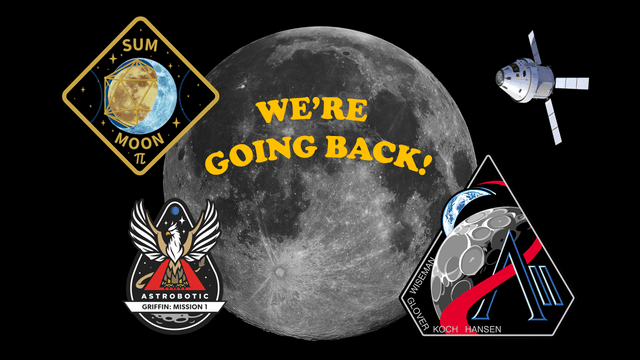
You can view the video here: We’re Going Back to the Moon!
Exciting news!
We’re going back to the moon: there are two missions this year (2026) where we’re launching spacecraft to the moon - one of them is even crewed!
This is very exciting because we’ve not sent humans this far from Earth since 1972, which is over 50 years ago. So, you can imagine that the research that we’re doing now is not only groundbreaking, but is also really important.
Artemis II
The first of these is NASA’s Artemis II, which will carry a crew of four people to make observations of the dark side of the moon. To look at the dark side of the moon, you need to go all the way around the moon, and that’s exactly what they’ll be doing in a ten-day mission in February this year.
They hope to make observations of the geology and landscape of the back of the moon, collect weather data on things like coronal mass ejections and solar flares, and they’re also going to be researching how our bodies respond to spaceflight, monitoring everything from sleep patterns to the effect of radiation.
Information about the Artemis II mission can be found on the NASA website.
Griffin Mission One
The second mission is Astrobotic’s Griffin Mission One (Griffin-1), which hopes to land a rover on the lunar surface. The major purpose of sending this rover is to test their technology, with the long term goal of making rover tech available to companies.
The initial hundred-day mission will be launched in a SpaceX Falcon Heavy rocket, and the rover is equipped with advanced autonomous navigation systems, which - if they work - will dramatically reduce the risk of rover exploration.
More excitingly for me, though, Griffin-1’s main payload - the CubeRover-1 - will be used to calculate $\pi$ (pi) on the moon! Although its main purpose is to test the onboard radioisotope heater and the communication systems.
Find out more about Griffin Mission One and Astrobotic’s other missions in their moon manifest. Matt Parker is responsible for calculating $\pi$ on the moon and you can find out more about it on the Moon Pi website and the Kickstarter page.
Sources
Information was sourced from the NASA and Astrobotic websites.
Image Credit:
- “The Moon (near side)” by Gregory H. Revera, CC BY-SA 3.0 [modified], via Wikimedia Commons
- “Orion with the ESA Service Module” by NASA, CC BY-NC-ND 2.0 [modified], via Flickr
- Mission patches from NASA, Astrobotic, and Matt Parker (Moon Pi)
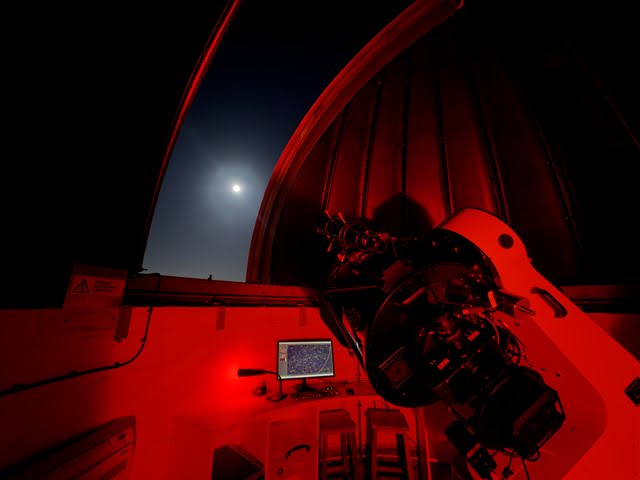
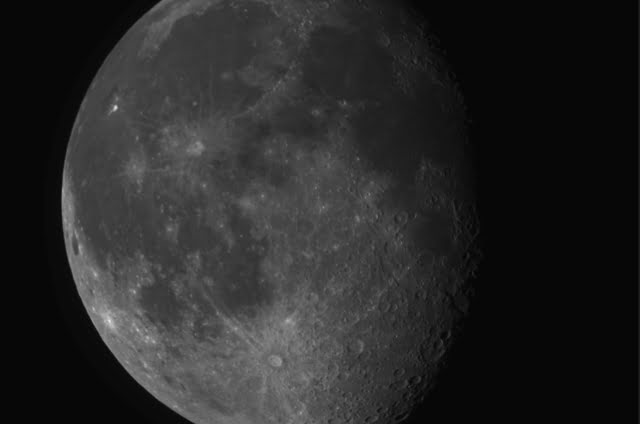
- Images of the observatory and moon are kindly provided by Royal Holloway, University of London